

 Persly Medical Team
Based on PubMed | Can sudden back pain be a symptom of testicular cancer, and what mechanisms explain this association?
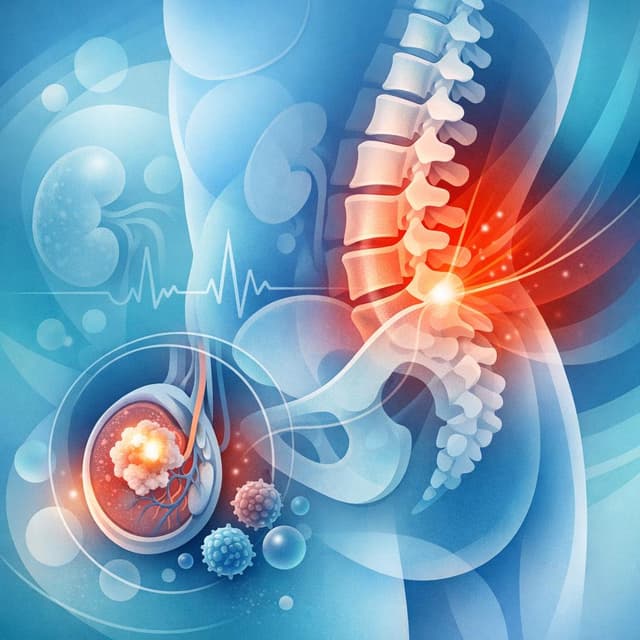
Back pain can be a symptom of testicular cancer, most often when the disease has spread to retroperitoneal lymph nodes behind the abdomen. Enlarged nodes can cause mass effect or nerve irritation leading to lower back or flank pain; less commonly, bone metastases contribute so persistent back pain in young men warrants testicular exam, ultrasound, tumor markers, and imaging.
Yes back pain can be a symptom of testicular cancer, although it is more commonly seen when the disease has spread beyond the testicle. [1] In advanced cases, testicular cancer often involves lymph nodes behind the abdominal organs (the retroperitoneum), and this involvement can cause lower back pain. [2] [3]
How testicular cancer leads to back pain
- Retroperitoneal lymph node metastases: Testicular cancer frequently spreads first to lymph nodes along the aorta and vena cava in the back of the abdomen (para‑aortic/retroperitoneal nodes). [4] Enlarged nodes in this area can irritate nearby tissues and cause a deep, persistent ache in the lower back or flank. [3]
- Mass effect and pressure on structures: As metastatic nodes enlarge, they can press on surrounding muscles, ligaments, and organs in the retroperitoneal space, producing back or abdominal pain. [3] This “mass effect” is a common mechanical reason for cancer‑related back pain in this setting. [3]
- Nerve involvement: Bulky nodal disease can impinge on the lumbar plexus or nerve roots, leading to back pain that may radiate to the abdomen, groin, or legs; while not always explicitly reported in summaries, this mechanism aligns with how retroperitoneal masses generate pain. [3]
- Direct spread to other sites: When testicular cancer spreads to organs such as the liver, bones, or lungs, it can cause pain in those areas; bone metastases, although less common, may cause localized or referred back pain. [2]
- Bleeding within the testis (less common): About 1 in 10 men with testicular cancer may experience acute testicular pain from bleeding or infarction in the tumor, which can coexist with abdominal or back discomfort if disease is more advanced. [5]
What the evidence shows
- Authoritative clinical resources list back pain among the possible signs of testicular cancer, particularly when disease has progressed beyond the testicle. [1] [6] Symptoms may include a lump in the testicle, a dull lower belly or groin ache, scrotal discomfort, breast tenderness, and sometimes back pain. [1] [6]
- In more advanced disease, men may experience pain in the abdomen, back, or flank, consistent with retroperitoneal spread. [3] Patient education resources also note that symptoms in the back can occur if the cancer has spread outside the testicles. [7]
Can back pain be the first sign?
- While most men first notice a testicular lump or swelling, back pain can occasionally be an early presenting symptom especially in metastatic cases. [1] Case series have documented young men presenting with back pain due to para‑aortic lymph node metastases from testicular germ cell tumors, sometimes without obvious testicular enlargement at first. [8]
- In surveillance after initial treatment, new lumbar pain has preceded imaging abnormalities by months in some relapses, underscoring that back pain can signal retroperitoneal disease even before scans show changes. [9] Rare case reports also describe persistent lower back pain as the presenting symptom in otherwise healthy young men, later found to have retroperitoneal metastasis from testicular cancer. [10]
How “sudden” is the pain?
- Back pain from retroperitoneal nodes often develops gradually as nodes enlarge, but the onset can feel sudden to the person if the pain crosses a threshold or follows a triggering activity. [3] Acute, sharp back pain is less typical but may occur depending on the tumor’s location, rapid growth, or secondary issues like muscle spasm. [3]
- By contrast, sudden sharp pain in the testicle itself may occur with tumor bleeding or infarction; this is distinct from the deeper, duller back pain linked to retroperitoneal spread. [5]
Red flags that warrant prompt evaluation
- A testicular lump or swelling, a feeling of heaviness in the scrotum, a dull ache in the lower abdomen/groin, or persistent back pain especially in men aged 15–45 should be assessed. [1] [6]
- Back pain accompanied by weight loss, night sweats, persistent abdominal pain or fullness, or swollen nodes raises concern for systemic illness and merits timely medical review. [7]
What to do if you’re concerned
- Self‑check the testicles for any lump, firmness, or asymmetry; most testicular cancers present with a palpable mass. [1]
- Seek medical care for a focused exam and, if indicated, scrotal ultrasound and blood tests for tumor markers (AFP, β‑hCG, LDH), which guide diagnosis and staging when testicular cancer is suspected. [2]
- If back pain is prominent or persistent, doctors may order abdominal/pelvic imaging to evaluate retroperitoneal lymph nodes, since this is the first typical site of spread. [4]
Key takeaways
- Back pain can be a symptom of testicular cancer, most often when the cancer has spread to retroperitoneal lymph nodes behind the abdomen. [1] [3]
- Mechanisms include nodal metastasis causing mass effect and nerve irritation, and less commonly spread to bone or other organs. [3] [2]
- Although back pain alone is rarely the first sign, it has been documented even without an obvious testicular mass so persistent or unexplained back pain in young men deserves a careful testicular exam and appropriate work‑up. [8] [10] [9]
Related Questions
Related Articles


Sources
- 1.^abcdefgTesticular cancer - Symptoms and causes(mayoclinic.org)
- 2.^abcdTesticular cancer - Symptoms and causes(mayoclinic.org)
- 3.^abcdefghijTypes of Testicular Cancer(nyulangone.org)
- 4.^abSurgery for Testicular Cancer(nyulangone.org)
- 5.^ab국가암정보센터(cancer.go.kr)
- 6.^abcTesticular cancer - Symptoms and causes(mayoclinic.org)
- 7.^abTesticular cancer: MedlinePlus Medical Encyclopedia(medlineplus.gov)
- 8.^abBack pain--a presentation of metastatic testicular germ cell tumours.(pubmed.ncbi.nlm.nih.gov)
- 9.^abLumbar pain in stage 1 testicular germ cell tumours: a symptom preceding radiological abnormality.(pubmed.ncbi.nlm.nih.gov)
- 10.^abMetastatic testicular cancer presenting as lower back pain in a pilot.(pubmed.ncbi.nlm.nih.gov)
Important Notice: This information is provided for educational purposes only and is not intended to replace professional medical advice, diagnosis, or treatment. Always consult with a qualified healthcare provider before making any medical decisions.