
 Persly Medical Team
Elevated CRP in Melanoma: What It Means
Elevated CRP in Melanoma: What It Means
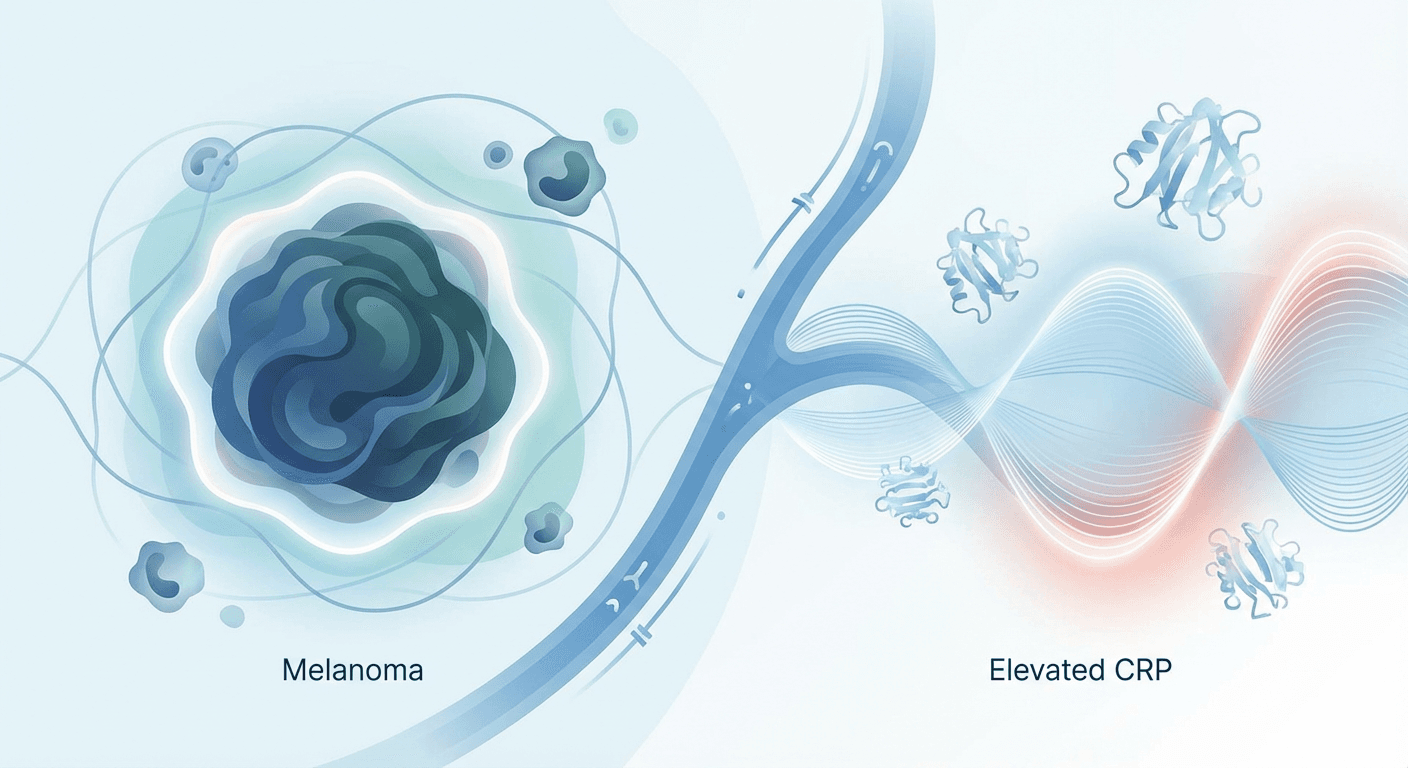
An elevated C‑reactive protein (CRP) generally indicates inflammation somewhere in the body, which can come from many causes, not just cancer. In melanoma, higher CRP levels have been associated in research with greater disease burden and, in advanced stages, with poorer survival, but CRP is a nonspecific marker and should be interpreted alongside symptoms, imaging, and other labs. [1] [2]
What CRP Measures
- CRP is a protein your liver makes in response to inflammation (for example, from infection, injury, autoimmune activity, or cancer). Because CRP is nonspecific, elevations can result from common issues like infections or flares of chronic inflammatory conditions. [1] [3]
- Typical clinical CRP (not “hs‑CRP”) is used to detect or monitor inflammation; it does not diagnose melanoma or any cancer by itself. Tumor marker tests are different and more specific; CRP is not a melanoma tumor marker. [3] [4]
CRP and Melanoma: What Studies Suggest
- Across advanced cancers including melanoma higher CRP has been linked with worse outcomes, reflecting the impact of systemic inflammation. In melanoma specifically, elevated baseline CRP has been reported as a prognostic indicator in several cohorts. [5] [2]
- With modern immunotherapy (immune checkpoint inhibitors), early changes in CRP during the first 1–3 months of treatment have shown prognostic value:
- “All‑normal” CRP (staying below the lab’s upper limit of normal) correlated with the longest progression‑free and overall survival. Patients whose CRP did not improve (“nonresponders”) had shorter survival, while those with early decreases or a transient flare followed by drop had intermediate outcomes. [6]
- Similar patterns have been validated in other populations, suggesting CRP kinetics can help monitor response during immunotherapy. These classifications are emerging tools and are used together with scans, exams, and other labs. [7] [8]
Important Limitations
- CRP is not specific to melanoma a cold, dental infection, arthritis flare, or other inflammatory condition can raise CRP. [1]
- CRP does not replace imaging or physician assessment; it is one piece of the puzzle, often combined with lactate dehydrogenase (LDH), blood counts, and circulating tumor DNA (ctDNA) when available. [9] [10]
- Cutoffs and trends matter more than a single value; a one‑time elevation is less informative than how CRP changes over time in context of treatment and symptoms. [9] [6]
When to Be Concerned
- It can be reasonable to be cautious if CRP is persistently high, especially with new or worsening symptoms (pain, fevers, weight loss) or rising LDH. Persistent elevation coupled with clinical changes may suggest disease activity and warrants medical review. [9] [5]
- If you are on immunotherapy, CRP patterns over the first three months can provide supportive clues about response; your oncology team may track CRP alongside scan schedules. [6] [7]
Practical Next Steps
- Check the context: Were you ill recently (cold, COVID‑19, urinary or dental infection), or do you have other inflammatory conditions (autoimmune disease)? These can transiently raise CRP. [1]
- Review trends: Ask for prior CRP results to see if the level is stable, rising, or falling; trends help interpretation. Pair CRP with symptoms and upcoming imaging to guide decisions. [9]
- Coordinate timing: If CRP was drawn during an infection, consider rechecking after recovery to avoid unnecessary worry. Your clinician may also order LDH, blood counts, or ctDNA depending on your stage and treatment plan. [9] [10]
- Discuss thresholds: Many labs consider CRP above the upper limit (often around 8–10 mg/L, varies by lab) as elevated; your care team can advise how that cutoff applies to you and whether repeat testing is useful. [11]
Key Takeaways
- Elevated CRP signals inflammation, not necessarily melanoma progression. [1]
- In advanced melanoma, higher or persistently elevated CRP has been associated with worse outcomes, especially when aligned with other signs of disease. [2] [5]
- During immunotherapy, CRP trends over the first 1–3 months can add prognostic insight, but decisions are still based on the full clinical picture and imaging. [6] [7]
Frequently Asked Questions
Is CRP a melanoma screening or diagnostic test?
No. CRP cannot diagnose melanoma; it only flags inflammation. Diagnosis and monitoring rely on exams, pathology, imaging, and, in some cases, ctDNA. [4] [10]
Can CRP help monitor my treatment?
It can help as a supportive biomarker, especially with immunotherapy, but it should be combined with scans and other labs. [6] [7]
What else can raise CRP?
Common infections, autoimmune conditions, injuries, and other diseases. That’s why a single high CRP is often rechecked after recovery or treated causes. [1] [3]
If you’d like, share your recent CRP value, stage, current treatment, and any symptoms so we can put it into clearer context for you 더 궁금하면 퍼슬리에게 편하게 물어보세요.
Related Questions
Related Articles


Sources
- 1.^abcdefC-reactive protein: MedlinePlus Medical Encyclopedia(medlineplus.gov)
- 2.^abcThe role of C-reactive protein as a prognostic indicator in advanced cancer.(pubmed.ncbi.nlm.nih.gov)
- 3.^abcC-Reactive Protein (CRP) Test: MedlinePlus Medical Test(medlineplus.gov)
- 4.^abCancer blood tests: Lab tests used in cancer diagnosis(mayoclinic.org)
- 5.^abcThe role of the systemic inflammatory response in predicting outcomes in patients with advanced inoperable cancer: Systematic review and meta-analysis.(pubmed.ncbi.nlm.nih.gov)
- 6.^abcdeC-reactive protein kinetics as prognostic biomarkers in advanced melanoma treated with immune checkpoint inhibitors.(pubmed.ncbi.nlm.nih.gov)
- 7.^abcdC-Reactive Protein Kinetics as Prognostic Biomarkers in Stage IV-Melanoma Treated With Immune Checkpoint Inhibitors in the Japanese Population: A Single-Center, Retrospective Cohort Study.(pubmed.ncbi.nlm.nih.gov)
- 8.^↑Predictive Factors in Metastatic Melanoma Treated with Immune Checkpoint Inhibitors: From Clinical Practice to Future Perspective.(pubmed.ncbi.nlm.nih.gov)
- 9.^abcdePredicting response and toxicity to immune checkpoint inhibitors using routinely available blood and clinical markers.(pubmed.ncbi.nlm.nih.gov)
- 10.^abcGene-Based Blood Test for Melanoma Spread Evaluates Treatment Progress(nyulangone.org)
- 11.^↑C-Reactive Protein (CRP) Test: MedlinePlus Medical Test(medlineplus.gov)
Important Notice: This information is provided for educational purposes only and is not intended to replace professional medical advice, diagnosis, or treatment. Always consult with a qualified healthcare provider before making any medical decisions.