
 Persly Medical Team
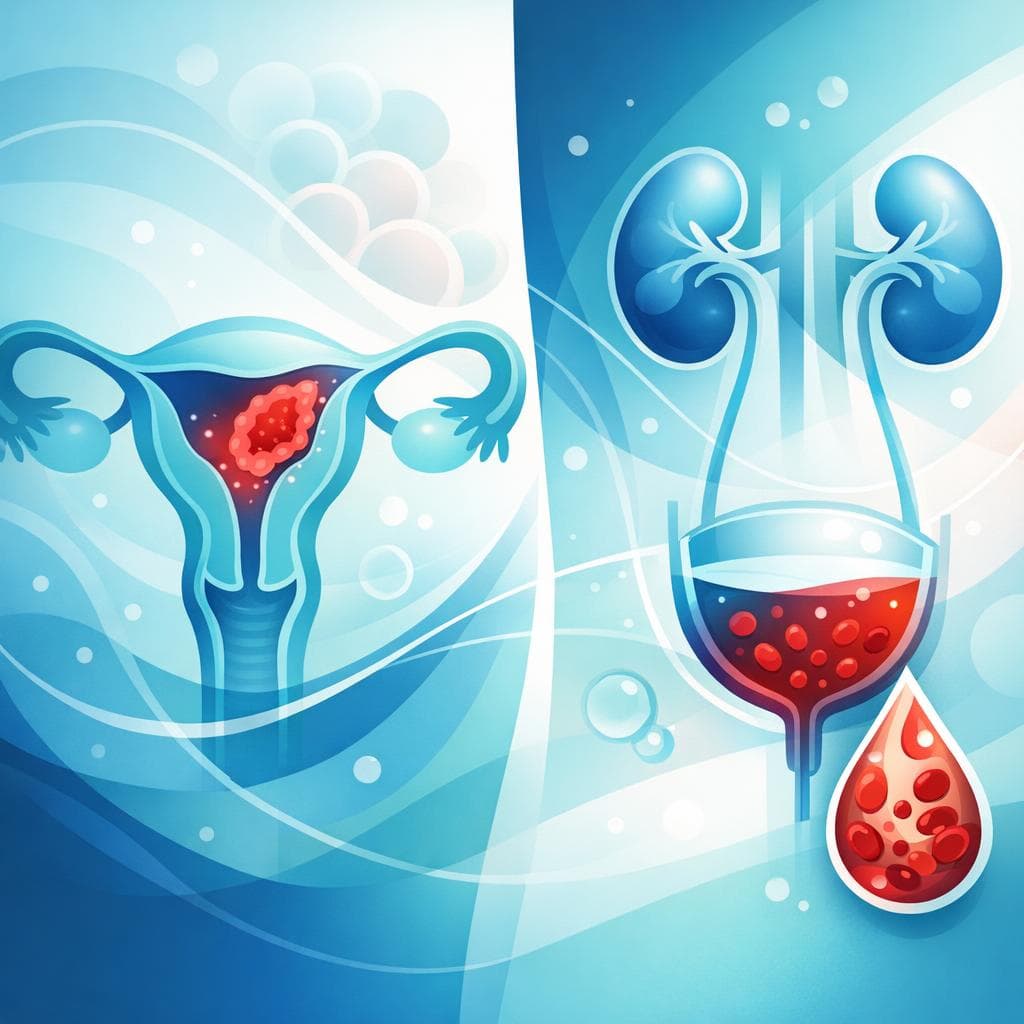
Based on NIH | Can blood in the urine be an early sign of endometrial cancer?
Blood in the urine is generally not an early sign of endometrial cancer. The hallmark early symptom is abnormal vaginal bleeding, while hematuria usually indicates urinary tract conditions and typically appears only with advanced uterine cancer that has invaded the bladder.
Blood in the urine (hematuria) is generally not an early sign of endometrial (uterine lining) cancer. The most common early warning sign of endometrial cancer is abnormal vaginal bleeding such as bleeding after menopause, bleeding between periods, or unusually heavy or prolonged menstrual bleeding rather than urinary bleeding. [1] Abnormal vaginal bleeding remains the key symptom that prompts evaluation and leads to diagnosis in most cases. [2]
What hematuria usually means
Most visible or microscopic blood in the urine comes from conditions within the urinary tract (kidneys, ureters, bladder, or urethra), such as urinary tract infection, kidney stones, inflammation, kidney disease, or urologic cancers (especially bladder or kidney). [3] When hematuria is present, it should be evaluated as a potential urinary tract problem because it can sometimes be a sign of cancers of the kidney or bladder, particularly when the blood is visible. [4]
When hematuria relates to endometrial cancer
Hematuria can occur with endometrial cancer, but this is typically associated with more advanced disease where the tumor has spread and directly involves the bladder (a stage IV feature), rather than as an early presentation. [5] In recognized staging systems, invasion of the bladder or bowel mucosa is classified as stage IVA disease, which is considered advanced. [5] National resources also note that if endometrial cancer spreads to the bladder, symptoms can include blood in the urine and frequent urination again indicating spread rather than an early-stage finding. [6]
Key early symptom of endometrial cancer
The symptom that most often leads to an early diagnosis is abnormal uterine/vaginal bleeding, especially postmenopausal bleeding; after menopause, any bleeding is not considered normal and should be evaluated. [2] Expert centers stress that noticing blood from the vagina, rectum, or urine should prompt medical attention, but in the context of endometrial cancer, the focus is on vaginal/uterine bleeding as the typical early sign. [7]
Practical takeaways
- Hematuria by itself is far more likely to reflect a urinary tract condition than early endometrial cancer. [3]
- Visible blood in urine warrants timely medical evaluation because it can signal kidney or bladder cancer, among other causes. [4]
- For endometrial cancer, the hallmark early warning sign is abnormal vaginal bleeding; this should prompt gynecologic evaluation with consideration of transvaginal ultrasound and/or endometrial sampling when appropriate. [1] [2]
- Hematuria connected to endometrial cancer tends to indicate advanced disease with bladder involvement rather than an initial presentation. [5] [6]
Quick comparison: bleeding patterns and likely origin
| Bleeding feature | More typical source | Notes |
|---|---|---|
| Blood mixed in urine stream (pink/red/brown urine), with or without clots | Urinary tract (kidney, ureter, bladder, urethra) | Needs urologic workup due to possibilities from infection to kidney/bladder cancer. [3] [4] |
| Vaginal spotting or bleeding after menopause | Uterus/endometrium | Classic early sign of endometrial cancer; evaluate promptly. [1] [2] |
| Bleeding between periods or unusually heavy/prolonged periods | Uterus/endometrium | Can be a symptom of endometrial pathology, including cancer. [1] |
| Hematuria together with known endometrial cancer | Possible advanced spread to bladder | Represents stage IVA when bladder mucosa is invaded. [5] [6] |
What to do if you see blood
- If you see blood in urine, seek evaluation to identify urinary causes and rule out serious conditions; this often includes urinalysis and, depending on findings and risk, imaging and cystoscopy. [8]
- If you have postmenopausal vaginal bleeding or unusual vaginal bleeding patterns, consider prompt gynecologic assessment because this is the common route to diagnosing endometrial cancer. [2] [1]
In summary, hematuria alone is unlikely to be an early sign of endometrial cancer; it more commonly reflects urinary tract issues and only suggests endometrial cancer when there is advanced spread to the bladder, whereas abnormal vaginal bleeding is the typical early warning sign that should not be ignored. [3] [4] [5] [6] [2] [1]
Related Questions
Related Articles


Sources
- 1.^abcdefEndometrial cancer.(pubmed.ncbi.nlm.nih.gov)
- 2.^abcdefFast-track endometrial cancer care at Mayo Clinic(mayoclinic.org)
- 3.^abcdUrine - bloody : MedlinePlus Medical Encyclopedia(medlineplus.gov)
- 4.^abcdBlood in urine (hematuria) - Symptoms and causes(mayoclinic.org)
- 5.^abcde3060-FIGO staging for carcinoma of the endometrium(eviq.org.au)
- 6.^abcd국가암정보센터(cancer.go.kr)
- 7.^↑Fast-track endometrial cancer care at Mayo Clinic(mayoclinic.org)
- 8.^↑Blood in urine (hematuria) - Diagnosis and treatment(mayoclinic.org)
Important Notice: This information is provided for educational purposes only and is not intended to replace professional medical advice, diagnosis, or treatment. Always consult with a qualified healthcare provider before making any medical decisions.