
 Persly Medical Team
Based on PubMed | Can blood in the stool occur in advanced endometrial cancer, and what does it indicate about metastasis or invasion of the gastrointestinal tract?
Blood in the stool can occur in advanced endometrial cancer and may reflect rectal invasion (stage IV) or, rarely, bowel metastasis; however, radiation proctitis and unrelated GI causes are also common. Prompt evaluation with colonoscopy/EGD, imaging, and biopsy is essential to identify the source and guide treatment.
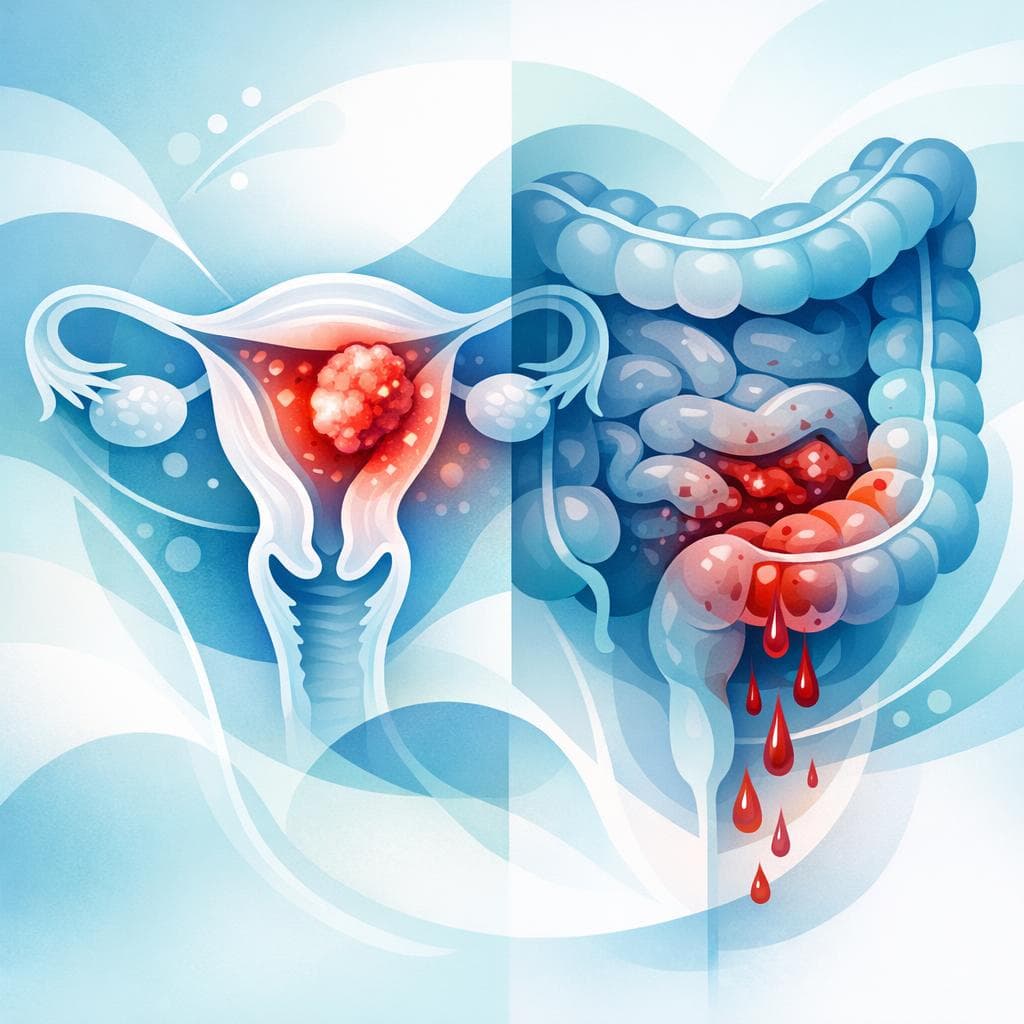
Blood in the stool can occur in advanced endometrial (uterine) cancer, but it is not a common first sign; when it happens, it may reflect several possibilities ranging from treatment‑related side effects to direct tumor involvement of the bowel or a second, unrelated gastrointestinal condition. In particular, spread to the rectum or colon is considered stage IV disease and can present with rectal bleeding (hematochezia) or dark, tarry stools (melena) depending on the site and rate of bleeding. [1] [2]
How endometrial cancer involves the bowel
- Direct invasion of nearby organs: In the most advanced stage, endometrial cancer can extend to adjacent pelvic organs such as the bladder or rectum, which formally defines stage IV disease. Rectal involvement at this stage may lead to bleeding with bowel movements. [1] [2]
- Distant metastasis to the colon/rectum: Although uncommon, endometrial cancer can metastasize to segments of the colon and present as a bleeding mass that may mimic primary colorectal cancer on colonoscopy; immunohistochemistry is often needed to confirm the endometrial origin. Published case reports describe hematochezia from colonic metastases years after initial uterine treatment, highlighting that bowel metastasis is rare but possible. [3] [4]
Other common reasons for blood in the stool in this setting
- Radiation‑related proctitis/enteritis: Pelvic external‑beam radiation increases the risk of rectal bleeding; most cases are mild, but a small proportion require intervention. Studies in endometrial cancer survivors show any rectal bleeding in roughly 15–18% after external beam radiation, with severe bleeding being uncommon. [5]
- Treatment side effects and mucosal irritation: Systemic therapy can cause gastrointestinal irritation; patient information for systemic regimens also educates about dark or tarry stools as a warning sign that needs prompt medical attention. Tarry, sticky stools can indicate upper GI bleeding that warrants urgent evaluation. [6] [7]
- Unrelated gastrointestinal disease: Hemorrhoids, diverticulosis, angiodysplasia, inflammatory bowel disease, or a new primary colorectal cancer are all possibilities in anyone with rectal bleeding. In people with cancer, gastrointestinal bleeding is relatively common and requires rapid assessment because sources may be malignant or benign. [8]
What blood in the stool may indicate clinically
- Possible rectal invasion or colonic metastasis when bleeding is persistent, new, or associated with other signs (new bowel habit changes, weight loss, pelvic pain, or anemia). Such involvement would upstage disease to stage IV if confirmed. [1] [2]
- Possible radiation proctitis if bleeding appears months to years after pelvic radiation, particularly with mucus, urgency, or tenesmus; most cases are mild. External‑beam radiotherapy carries a higher risk of rectal bleeding than vaginal brachytherapy alone. [5]
- Possible unrelated GI pathology that coincidentally occurs and must not be overlooked; endoscopy is essential to identify the source. Endoscopy remains the cornerstone for diagnosing and managing GI bleeding in people with cancer. [8]
Recommended evaluation if blood appears in the stool
If you have known or suspected advanced endometrial cancer and notice rectal bleeding or black stools, medical teams generally pursue a structured work‑up to determine the cause and guide treatment:
- History and examination: Clarify color (bright red vs. black/tarry), amount, associated pain, bowel changes, prior pelvic radiation, and medications (anticoagulants, NSAIDs).
- Laboratory tests: Complete blood count to assess for anemia and hemodynamic stability; iron studies if chronic bleeding is suspected.
- Endoscopy to localize and diagnose the source:
- Colonoscopy for bright red blood per rectum or suspected lower GI source; biopsy any lesions to distinguish primary colorectal cancer from metastasis using immunohistochemical markers (for example, CK7‑positive/CK20‑negative pattern favoring endometrial origin). This approach is crucial because colonic metastases from endometrial cancer can mimic primary colorectal tumors. [3] [4]
- Upper endoscopy if stools are black/tarry or if an upper source is suspected; this is important because cancer therapies can predispose to upper GI mucosal injury. Endoscopy is the mainstay of diagnosis and initial management in cancer‑related GI bleeding. [8]
- Cross‑sectional imaging (CT or MRI): Pelvic and abdominal imaging helps evaluate for local invasion into the rectum, regional lymphadenopathy, and distant metastasis; imaging can also guide targeted biopsy of suspicious nodes or masses. While useful for mapping disease and guiding biopsy, cross‑sectional imaging can miss small metastases and cannot on its own exclude spread. [9]
- Tissue confirmation: If a bowel lesion is found, biopsy with pathology and immunohistochemistry is used to determine whether it represents metastatic endometrial carcinoma versus a new primary colorectal cancer, which have different treatments and prognoses. IHC patterns help differentiate origins when colon lesions are found in people with prior uterine cancer. [3] [4]
How common is bowel involvement?
- Rectal or bladder involvement defines stage IV disease on widely used staging schemes, emphasizing that direct extension to the rectum does occur but is not the majority presentation. Most endometrial cancers are diagnosed at earlier stages, and bowel involvement is relatively uncommon overall. [1]
- Distant colonic metastases are rare. Published accounts are mainly case reports, underscoring the need to keep the possibility in mind but also to investigate for more common causes of bleeding. Because of this rarity, a new colonic mass in someone with endometrial cancer must be carefully profiled to avoid misclassification. [3] [4]
What to do and when to act
- Seek prompt medical evaluation for any new rectal bleeding or black/tarry stools, especially if you have a history of endometrial cancer or pelvic radiation. Dark, tarry, or sticky bowel movements are a warning sign that should be reported immediately. [6] [7]
- Expect a stepwise work‑up with endoscopy and imaging to determine the cause and tailor treatment; early identification improves options for local control, symptom relief, and systemic therapy planning. Endoscopy-directed diagnosis allows both source control (for active bleeding) and definitive pathology. [8]
Key takeaways
- Yes, blood in the stool can occur in advanced endometrial cancer. It may indicate rectal invasion (stage IV) or rare colonic metastasis, but it can also result from radiation proctitis or unrelated GI conditions like hemorrhoids. [1] [2] [5] [3]
- Do not assume the cause. A careful evaluation with colonoscopy/EGD, imaging, and biopsy is needed to distinguish tumor involvement from other causes and to guide treatment. Endoscopy is central to diagnosis and management in cancer‑related GI bleeding. [8] [3] [4] [9]
Related Questions
Related Articles


Sources
- 1.^abcdeEndometrial Cancer (V3)(stanfordhealthcare.org)
- 2.^abcdEndometrial Cancer (V3)(stanfordhealthcare.org)
- 3.^abcdefMetastatic Endometrial Cancer to the Sigmoid Colon Masquerading as Primary Colorectal Cancer.(pubmed.ncbi.nlm.nih.gov)
- 4.^abcdeDelayed metastatic endometrial carcinoma mimicking primary colon adenocarcinoma: A surprise histopathological finding.(pubmed.ncbi.nlm.nih.gov)
- 5.^abcRectal bleeding after radiation therapy for endometrial cancer.(pubmed.ncbi.nlm.nih.gov)
- 6.^abPatient information - Endometrial cancer recurrent or metastatic - Carboplatin, paclitaxel and durvalumab(eviq.org.au)
- 7.^abPatient information - Endometrial cancer recurrent or metastatic - Carboplatin, paclitaxel and dostarlimab(eviq.org.au)
- 8.^abcdeGastrointestinal bleeding in the cancer patient.(pubmed.ncbi.nlm.nih.gov)
- 9.^abDiagnosis of endometrial cancer.(pubmed.ncbi.nlm.nih.gov)
Important Notice: This information is provided for educational purposes only and is not intended to replace professional medical advice, diagnosis, or treatment. Always consult with a qualified healthcare provider before making any medical decisions.