
 Persly Medical Team
Based on NIH | Does smoking in the morning reduce the effectiveness of omeprazole or interfere with its absorption?
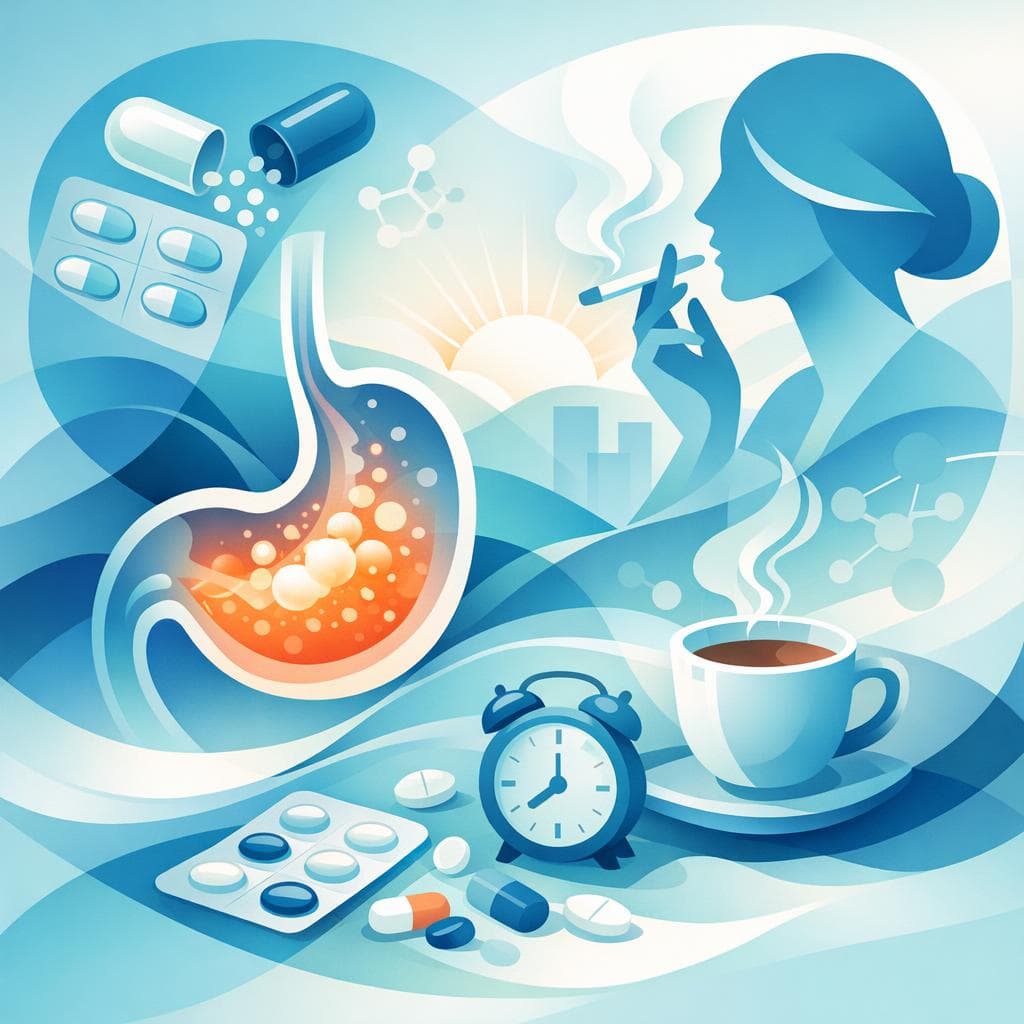
Smoking soon after taking omeprazole is unlikely to impair its absorption, but it can stimulate acid and worsen reflux, making the drug feel less effective. For best results, take omeprazole 30–60 minutes before breakfast and avoid smoking around the dose.
Smoking shortly after taking omeprazole is unlikely to block the pill’s absorption, but it can reduce the medicine’s overall acid‑suppressing effect and may worsen reflux symptoms, which can make omeprazole seem less effective. In practical terms, morning smoking doesn’t meaningfully impair omeprazole getting into your body, but it may blunt the benefit you feel from the drug by increasing acid and reflux triggers.
What smoking does to stomach acid and reflux
- Nicotine and smoke can stimulate gastric acid and pepsin secretion and relax the lower esophageal sphincter, which promotes reflux. Historically, smoking has been shown to counteract the acid‑reducing effect of older acid reducers at night, leading to more acid output when people smoked after dosing. [1] Because omeprazole’s goal is to keep stomach pH higher (less acidic), smoke‑driven acid stimulation and reflux can work against symptom control, even if the drug is absorbed normally. [1]
Does smoking change omeprazole absorption?
- Omeprazole is acid‑labile and formulated as a delayed‑release (enteric‑coated) product or combined with a buffer so it passes the stomach and is absorbed in the intestine. Official product information stresses that factors affecting gastric pH can alter other drugs, and that strong enzyme inducers can lower omeprazole exposure, but it does not list cigarette smoking as a known cause of reduced omeprazole absorption. [2] Labels also repeatedly advise people with heartburn to quit smoking as a lifestyle measure, which reflects its worsening effect on reflux rather than a proven absorption problem for omeprazole. [3] [4] [5]
Enzyme effects and metabolism
- Omeprazole is mainly cleared by the liver enzyme CYP2C19. Strong inducers like rifampin or St. John’s wort can lower omeprazole levels and effectiveness, but standard references do not classify smoking as a clinically significant inducer of CYP2C19 for omeprazole. [6] Smoking induces CYP1A enzymes in the gut, and omeprazole itself can induce CYP1A, but this has not been shown to meaningfully lower omeprazole blood levels or block its clinical effect via metabolism. [7]
Bottom line guidance
- Absorption: No clear evidence shows morning smoking prevents omeprazole from being absorbed; the drug’s enteric coating or buffering is designed to protect it until the intestine. [2]
- Effectiveness: Smoking can increase acid and reflux and has been observed to counteract acid suppression with other drugs, which can make symptoms persist despite omeprazole. [1]
- Practical advice: Take omeprazole 30–60 minutes before breakfast to allow activation in the acid pumps, and avoid smoking around this time to reduce reflux triggers and acid stimulation. [2] Lifestyle guidance on official labels (eat smaller meals, elevate the head of the bed, avoid tight clothing, and quit smoking) is recommended to improve symptom control alongside omeprazole. [3] [4] [8]
Quick reference table
| Question | What the evidence suggests | Practical takeaway |
|---|---|---|
| Does smoking reduce omeprazole absorption? | No direct evidence that smoking prevents absorption; labels do not list smoking as an absorption interaction. [2] | Absorption is generally preserved due to enteric coating/buffering. |
| Does smoking reduce omeprazole’s symptom control? | Smoking can increase acid secretion and reflux and has historically blunted acid suppression with other antisecretory drugs. [1] | You may feel less relief if you smoke, especially near dosing or at night. |
| Does smoking change omeprazole metabolism? | Clinically important reductions are linked to strong CYP2C19/3A4 inducers (e.g., rifampin), not smoking. [6] | Usual smoking does not appear to meaningfully lower omeprazole levels. |
How to optimize your dose if you smoke
- Timing: Take omeprazole first thing in the morning, 30–60 minutes before breakfast, and try to avoid smoking before and shortly after that dose to minimize reflux triggers that can mask benefit. [2]
- Consistency: Take it at the same time daily for at least several days; maximum effect often builds over 1–4 days. Some OTC labels note that full effect may take up to 1–14 days depending on formulation. [4] [5]
- Lifestyle: Quitting or cutting down on smoking can meaningfully improve reflux control and complement omeprazole. [3] [4] [8]
If you’re still having symptoms despite correct dosing and reduced smoking around the dose, it could be due to factors like the dose being too low, rapid metabolism (CYP2C19 genetic differences), nighttime reflux, or another diagnosis such as bile reflux or functional heartburn; in those cases, discussing alternative PPIs, dosing twice daily, or adjuncts like H2 blockers at night with a clinician may help. Omeprazole and related PPIs can affect or be affected by other medicines, so review your medication list with a professional if symptoms persist. [2] [9]
Related Questions
Related Articles


Sources
- 1.^abcdSmoking impairs therapeutic gastric inhibition.(pubmed.ncbi.nlm.nih.gov)
- 2.^abcdefDailyMed - OMEPRAZOLE capsule, delayed release(dailymed.nlm.nih.gov)
- 3.^abcOMEPRAZOLE- omeprazole magnesium tablet, delayed release(dailymed.nlm.nih.gov)
- 4.^abcdZEGERID OTC- omeprazole, sodium bicarbonate capsule(dailymed.nlm.nih.gov)
- 5.^ab(dailymed.nlm.nih.gov)
- 6.^abDailyMed - OMEPRAZOLE capsule, delayed release(dailymed.nlm.nih.gov)
- 7.^↑Induction of cytochrome P4501A by smoking or omeprazole in comparison with UDP-glucuronosyltransferase in biopsies of human duodenal mucosa.(pubmed.ncbi.nlm.nih.gov)
- 8.^abOMEPRAZOLE AND SODIUM BICARBONATE capsule(dailymed.nlm.nih.gov)
- 9.^↑An update on drug-drug interactions associated with proton pump inhibitors.(pubmed.ncbi.nlm.nih.gov)
Important Notice: This information is provided for educational purposes only and is not intended to replace professional medical advice, diagnosis, or treatment. Always consult with a qualified healthcare provider before making any medical decisions.