
 Persly Medical Team
Based on NIH | Is it safe to take naproxen if I eat spicy food in the morning, or does it increase the risk of stomach irritation or ulcers?
Spicy food doesn’t directly interact with naproxen or uniquely raise ulcer risk. However, naproxen can irritate the stomach and spicy meals may worsen symptoms; take it with a substantial, preferably non-spicy meal or milk, use the lowest effective dose, and consider gastroprotection if you have GI risk factors.
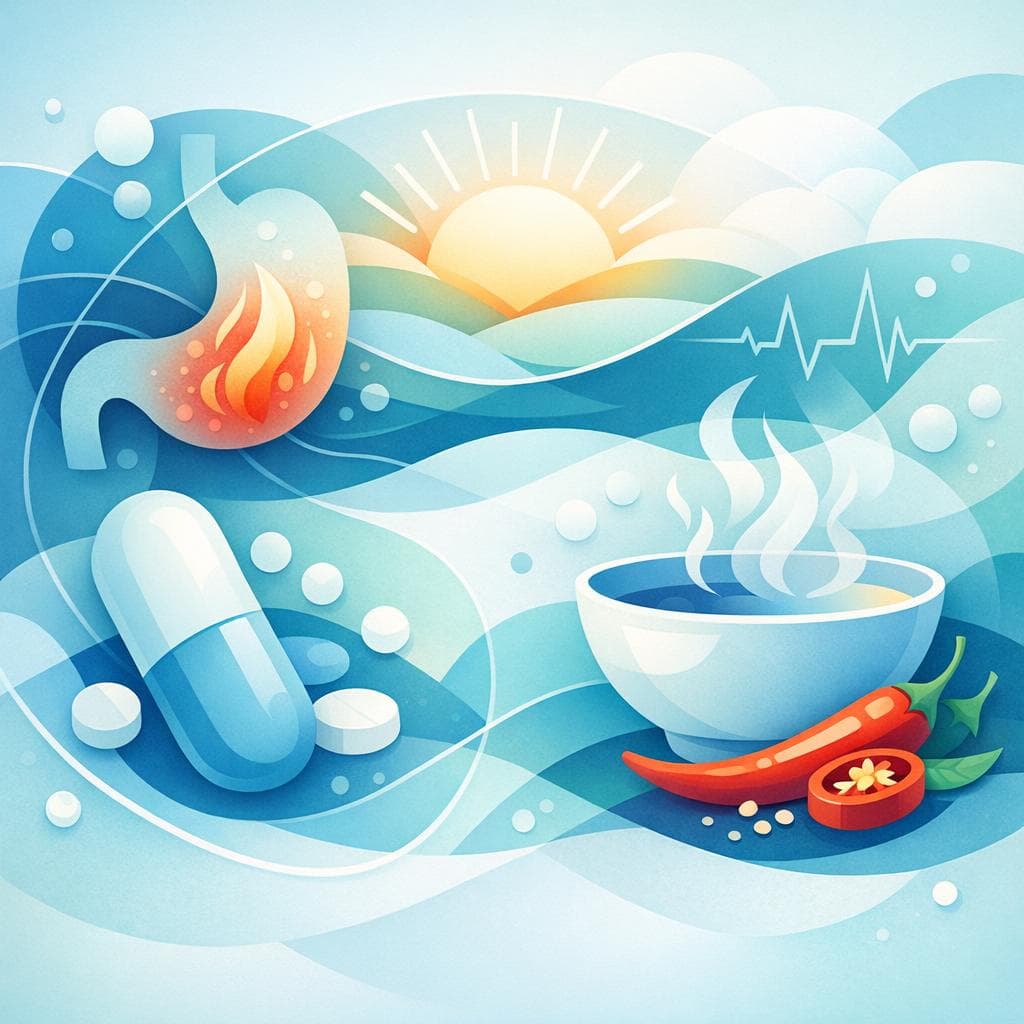
Taking naproxen with spicy food is generally possible, but it may not be the best choice if you’re concerned about stomach irritation. Naproxen is a nonsteroidal anti‑inflammatory drug (NSAID) that can irritate the stomach lining and increase the risk of gastritis, ulcers, and bleeding, especially with regular use or higher doses. Product labels advise taking naproxen with food or milk if stomach upset occurs, but they also warn about serious stomach bleeding risks in certain people. [1] These risks are higher if you are 60 or older, have a history of ulcers or GI bleeding, take blood thinners or steroids, use other NSAIDs, or drink 3 or more alcoholic drinks a day. [2] [3]
What naproxen does to the stomach
- NSAIDs like naproxen can damage the stomach and duodenal lining by reducing protective prostaglandins and by direct topical irritation. This can lead to dyspepsia, erosions, ulcers, and even bleeding or perforation in some cases. [4] [5]
- Epidemiology studies show NSAID users have a higher rate of ulcer complications, with risk amplified by older age, prior ulcer, alcohol use, and anticoagulants. A considerable proportion of chronic NSAID users develop mucosal injury, often without obvious symptoms. [6] [7]
Where spicy food fits in
- Spicy foods (chili/capsaicin) can cause a burning sensation but do not by themselves cause ulcers in most people. Evidence in humans is mixed and dose‑dependent, and some research suggests capsaicin may even have gastroprotective effects under certain conditions. However, real‑world tolerance varies, and spicy meals can worsen heartburn or dyspepsia in sensitive individuals, especially when the stomach lining is already stressed by NSAIDs.
- Early‑phase human studies have explored capsaicin alongside NSAIDs and suggested potential protective effects without altering some drug kinetics, but these are not standard clinical recommendations and are not a substitute for proven gastroprotection. In everyday practice, relying on spicy food to protect your stomach while taking naproxen is not advised. [8]
Practical guidance if you eat spicy food in the morning
- If you’re otherwise low risk, an occasional naproxen dose can be taken with a meal; labels suggest taking it with food or milk if you get stomach upset. [9] [10]
- Spicy food itself doesn’t directly interact with naproxen to increase drug levels or proven ulcer risk, but it can aggravate symptoms of irritation. If spicy breakfasts trigger heartburn or indigestion, pairing that with naproxen may make you feel worse, even if it doesn’t independently raise ulcer risk.
- For better tolerance, consider taking naproxen with a non‑spicy, substantial meal or with milk/yogurt; this can reduce stomach upset, though it does not fully prevent ulcer risk. [1] [11]
Who should be more cautious
- You may face higher GI risk if you are over 60, have a history of ulcers/bleeding, or take blood thinners, steroids, aspirin, other NSAIDs, or drink alcohol regularly. In these situations, naproxen can carry a significant bleeding risk regardless of food choice, and medical advice on prevention is important. [2] [3]
- Signs of serious GI problems include faintness, vomiting blood, black or bloody stools, or persistent stomach pain. Seek medical care if these occur. [11]
Ways to reduce stomach risk with naproxen
- Use the lowest effective dose for the shortest time needed. Shorter duration and lower dose reduce the chance of GI problems. [12]
- Take with a non‑spicy meal or milk if you notice upset. This can help with symptoms but does not eliminate ulcer risk. [9] [10]
- Avoid combining with other NSAIDs or frequent alcohol. Both increase the risk of bleeding and ulcers. [2] [3]
- If you have GI risk factors or need ongoing NSAID therapy, talk to your clinician about gastroprotection (for example, a proton‑pump inhibitor) or alternative pain options. Risk stratification and protective strategies are standard in people at higher GI risk. [13]
Bottom line
- Spicy food does not have a proven direct interaction with naproxen that uniquely increases ulcer risk, but naproxen itself can irritate the stomach and raise ulcer/bleeding risk, and spicy meals may worsen discomfort in some people. Taking naproxen with a substantial, non‑spicy meal or milk is a reasonable way to minimize symptoms, especially if you notice heartburn or indigestion with spicy breakfasts. If you have any GI risk factors or need naproxen regularly, consider protective measures and speak with your clinician. [1] [2] [13]
Quick reference table
| Topic | Key points | Practical tip |
|---|---|---|
| Naproxen GI risk | Can cause irritation, ulcers, bleeding; risk higher with age ≥60, prior ulcers, blood thinners, steroids, multiple NSAIDs, alcohol | Use lowest effective dose, shortest duration [2] [3] [12] |
| Food guidance | Taking with food or milk may reduce stomach upset (symptoms), not the underlying ulcer risk | Prefer a non‑spicy, substantial meal or milk/yogurt [9] [1] [10] [11] |
| Spicy food | May aggravate heartburn/dyspepsia in some; no established harmful interaction with naproxen | If spicy breakfast worsens symptoms, switch to bland breakfast when dosing |
| Warning signs | Black/tarry stools, vomiting blood, persistent stomach pain, feeling faint | Stop and seek medical care promptly [11] |
If you’d like, I can help tailor a safer dosing plan based on your age, any past stomach issues, and other medicines you’re taking.
Related Questions
Related Articles
Sources
- 1.^abcdALEVE- naproxen sodium tablet tablet(dailymed.nlm.nih.gov)
- 2.^abcdeALEVE- naproxen sodium tablet ALEVE, TRAVEL BASIX- naproxen sodium tablet(dailymed.nlm.nih.gov)
- 3.^abcdALL DAY RELIEF- naproxen sodium tablet(dailymed.nlm.nih.gov)
- 4.^↑NSAID, ulcers, and prostaglandins.(pubmed.ncbi.nlm.nih.gov)
- 5.^↑Nonsteroidal anti-inflammatory drugs: how do they damage gastroduodenal mucosa?(pubmed.ncbi.nlm.nih.gov)
- 6.^↑Epidemiology and NSAID induced gastropathy.(pubmed.ncbi.nlm.nih.gov)
- 7.^↑[Epidemiology and treatment of gastroduodenal lesions caused by non-steroidal anti-inflammatory agents].(pubmed.ncbi.nlm.nih.gov)
- 8.^↑Capsaicin as new orally applicable gastroprotective and therapeutic drug alone or in combination with nonsteroidal anti-inflammatory drugs in healthy human subjects and in patients.(pubmed.ncbi.nlm.nih.gov)
- 9.^abcALL DAY RELIEF- naproxen sodium tablet(dailymed.nlm.nih.gov)
- 10.^abcALEVE GELCAPS- naproxen sodium tablet, coated(dailymed.nlm.nih.gov)
- 11.^abcdALL DAY PAIN RELIEF- naproxen sodium tablet(dailymed.nlm.nih.gov)
- 12.^ab(dailymed.nlm.nih.gov)
- 13.^abNonsteroid anti-inflammatory drug-induced gastroduodenal injury.(pubmed.ncbi.nlm.nih.gov)
Important Notice: This information is provided for educational purposes only and is not intended to replace professional medical advice, diagnosis, or treatment. Always consult with a qualified healthcare provider before making any medical decisions.