
 Persly Medical Team
Based on FDA | Does taking doxycycline with olive oil reduce its absorption or effectiveness?
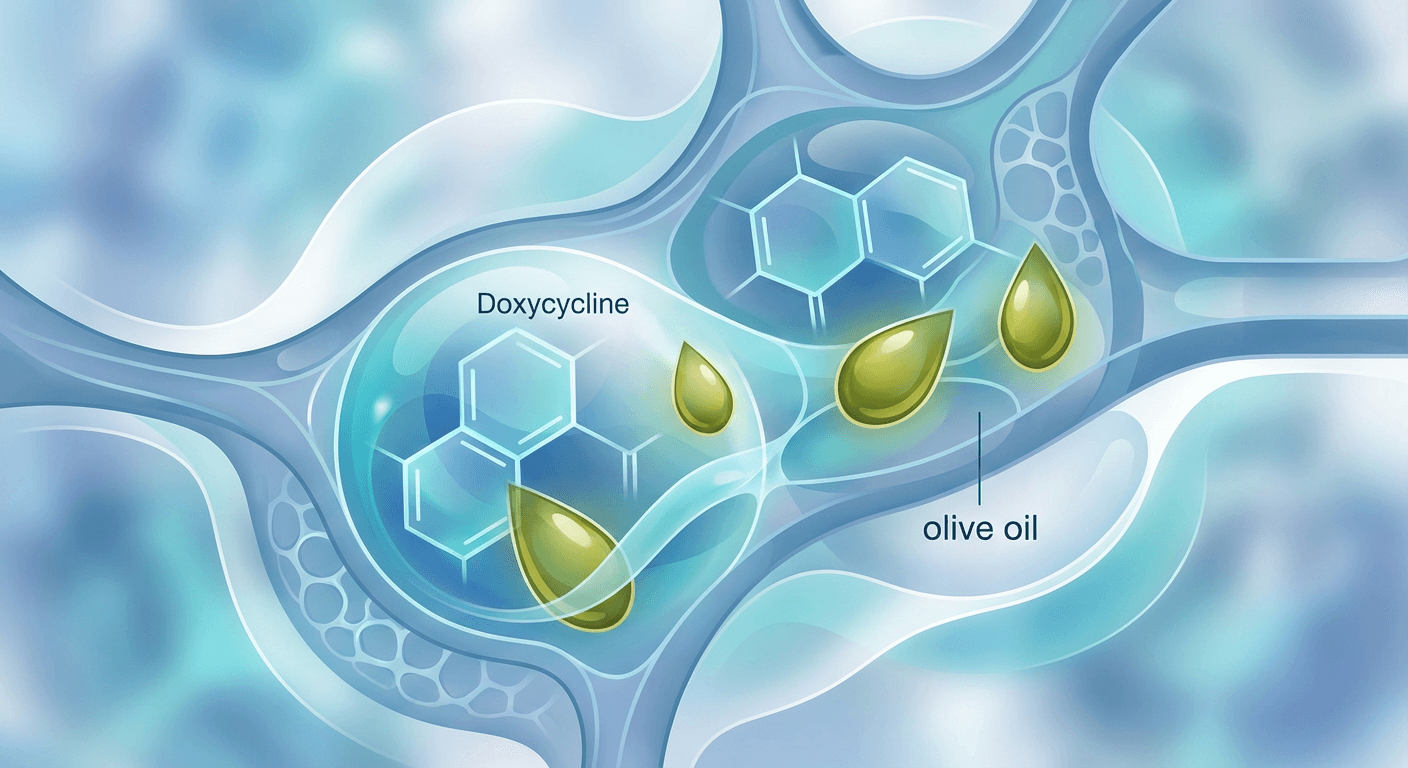
Olive oil (dietary fat) does not meaningfully reduce doxycycline absorption or effectiveness. Food may delay peak levels but has little effect on total exposure; more important is to separate minerals like calcium, magnesium, aluminum, iron, and bismuth by several hours.
Taking doxycycline with olive oil does not appear to meaningfully reduce its absorption or effectiveness. Most evidence shows that doxycycline’s overall absorption (how much gets into your bloodstream) is not significantly decreased by food, and high‑fat foods mainly slow the time it takes to reach peak levels rather than reducing total exposure. [1] [2] In several human studies and official product labels, food including high‑fat meals delayed peak concentration but had minimal impact on the total amount absorbed, and in some cases slightly increased overall exposure. This suggests olive oil, as a dietary fat, is unlikely to impair doxycycline’s effectiveness. [2] [3]
Key takeaways
- Food effect is small: Doxycycline absorption is generally well preserved with meals; any reduction is small and often not clinically important. [1] [4]
- High‑fat meals: Fat may slow the rate of absorption (later peak) but usually does not reduce the overall amount absorbed; sometimes total exposure is slightly higher. [2] [3]
- Olive oil specifically: There is no direct clinical study on olive oil and doxycycline, but based on doxycycline’s food‑effect profile, olive oil is unlikely to meaningfully reduce effectiveness. [1] [5]
- What to avoid: Products with divalent/trivalent cations calcium, magnesium, aluminum (e.g., dairy in excess, antacids), iron, and bismuth can bind tetracyclines and reduce absorption; space these at least 2–3 hours away from doxycycline. This interaction is well documented and more significant than any effect from fats like olive oil. [6] [7]
What the evidence shows
Food vs. no food
Official prescribing information indicates that the absorption of doxycycline is not markedly influenced by simultaneous ingestion of food or milk, and it can be taken with food if stomach upset occurs. [1] [8] In classic pharmacokinetic work comparing fasted and fed states, meal intake reduced tetracycline levels significantly, but doxycycline levels were only reduced by about 20%, which is considerably less and often not clinically relevant. [4]
High‑fat meals
For standard capsule/tablet formulations, a high‑fat meal delayed the time to reach peak concentration by roughly 1 hour 20 minutes, but the average peak concentration and total exposure (AUC) were slightly increased in the same study. This means fat slowed how fast the drug peaks, but didn’t reduce how much you ultimately absorb. [2] [3] For certain delayed‑release tablets at 150 mg, a high‑fat meal (including milk) decreased peak and AUC modestly, but the real‑world significance was reported as unknown; at 200 mg delayed‑release strength, bioavailability was not affected by food. [9] [10]
Olive oil specifically
There are no head‑to‑head clinical studies showing that olive oil reduces doxycycline absorption. Given doxycycline’s resilience to typical food effects and the observed patterns with high‑fat meals, olive oil in a meal is unlikely to meaningfully diminish efficacy. [1] [5] If anything, you might see a slightly delayed onset, which usually doesn’t matter for outcomes.
Practical guidance for taking doxycycline
- With or without food: You may take doxycycline with food to reduce nausea or stomach irritation; the overall effect on absorption is small. A glass of water and staying upright for 30 minutes helps prevent esophageal irritation. [1] [8]
- Olive oil is acceptable: Using olive oil in cooking or dressing your meal is unlikely to harm absorption; expect possibly slower peak but not reduced total absorption. [2] [3]
- Avoid binding agents near dose time:
- Calcium, magnesium, aluminum (antacids), iron supplements, multivitamins with minerals, and bismuth can bind doxycycline and lower absorption; separate by at least 2–3 hours before or 4–6 hours after doxycycline when possible. [6] [7]
- Large dairy servings close to dosing can have a minor effect; spacing them out is a reasonable precaution, especially with delayed‑release products sensitive to high‑fat + milk. [9] [10]
- Formulation matters: Some delayed‑release tablets show small food‑related changes; however, most standard capsule/tablet products are minimally affected by food. If you were prescribed a specific brand/formulation with unique instructions, follow that label. [9] [10] [1]
- If you feel nauseated: Taking the dose with a small meal or snack is appropriate and commonly recommended. This strategy usually improves tolerability without compromising effectiveness in a meaningful way. [1] [8]
Summary table: What affects doxycycline absorption?
| Factor | Effect on absorption | What to do |
|---|---|---|
| Food (general) | Minimal change in total absorption; may delay peak | Acceptable to take with food if upset stomach occurs [1] [4] |
| High‑fat meal | Delays peak; total exposure often unchanged or slightly ↑ | Acceptable; expect slower onset, not lower efficacy [2] [3] |
| Olive oil | No direct data; likely similar to other fats (minimal impact on AUC) | Safe to include in meals; no special precautions needed [1] [5] |
| Calcium/Magnesium/Aluminum (antacids), Iron, Bismuth | Can significantly reduce absorption via chelation | Separate doses by several hours [6] [7] |
| Milk/dairy | Typically small effect; more relevant with certain delayed‑release products | If concerned, space dairy away from dosing [1] [9] |
Bottom line
Based on human pharmacokinetic data and official labeling, taking doxycycline with olive oil should not reduce its overall absorption or effectiveness, though it may modestly slow how quickly blood levels peak. The key is to avoid minerals that bind doxycycline like calcium, magnesium, aluminum, iron, and bismuth near the time of your dose. [1] [2] [6] [7]
Related Questions
Related Articles


Sources
- 1.^abcdefghijklDoxycycline Tablets, USP(dailymed.nlm.nih.gov)
- 2.^abcdefg(dailymed.nlm.nih.gov)
- 3.^abcde(dailymed.nlm.nih.gov)
- 4.^abcBioavailability of tetracycline and doxycycline in fasted and nonfasted subjects.(pubmed.ncbi.nlm.nih.gov)
- 5.^abcAbsorption of doxycycline from a controlled release pellet formulation: the influence of food on bioavailability.(pubmed.ncbi.nlm.nih.gov)
- 6.^abcdDOXYCYCLINE HYCLATE tablet, delayed release(dailymed.nlm.nih.gov)
- 7.^abcddoxycycline(dailymed.nlm.nih.gov)
- 8.^abcDoxycycline(dailymed.nlm.nih.gov)
- 9.^abcdDOXYCYCLINE HYCLATE tablet, delayed release(dailymed.nlm.nih.gov)
- 10.^abcDOXYCYCLINE HYCLATE tablet, delayed release(dailymed.nlm.nih.gov)
Important Notice: This information is provided for educational purposes only and is not intended to replace professional medical advice, diagnosis, or treatment. Always consult with a qualified healthcare provider before making any medical decisions.